Santa Pola beaches
Santa Pola has about ten kilometres of coast, and the beaches are not interchangeable. Pick the wrong one with a two-year-old and you spend the day holding them up.
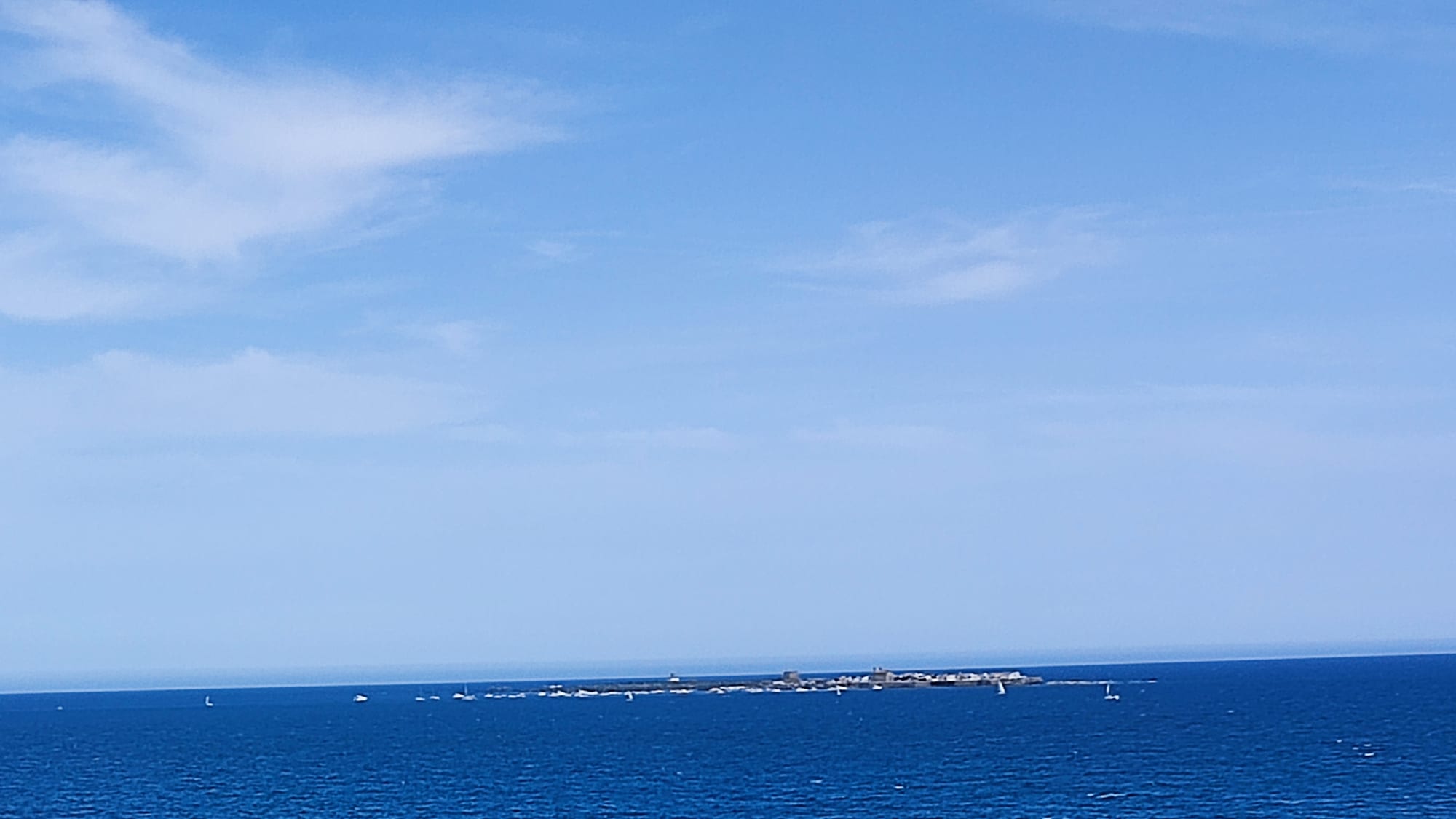
Santa Pola del Este, with Tabarca on the horizon. Our own photograph.
The short version
The thing that makes families come back
The western beaches — Gran Playa, Playa Lisa and Tamarit — are extraordinarily shallow. Not «shallow» in the way brochures use the word: you walk out tens of metres before the water reaches your waist.
If you have small children, that single fact is worth more than any other on this page. It means a toddler can stand up anywhere, and it means you can sit down rather than hover.
And if you want no waves at all, go to Santiago Bernabéu, right next to Playa de Levante. It has groynes acting as breakwaters, so the sea inside them sits like a millpond. That is the one for babies.
Playa de Levante: everything, and everyone
This is the middle of town and the busiest stretch by a distance. Pedal boats, paddleboard hire, sunbeds, bars, showers, lifeguards — whatever you forgot to bring, you can get it within fifty metres. The trade-off is obvious and it is August: it fills up.
The coves under the cape: the only snorkelling
Under the Cabo de Santa Pola, in the area known as Santa Pola del Este, the coast changes completely: rock, darker sand, and small coves instead of long beaches.
This is the only part of the municipality where snorkelling makes any sense. On the long sandy beaches there is genuinely nothing to look at underwater — sand, and more sand. Bring a mask here and it is a different holiday.
They are small coves, part rock and part darker sand, and several are an easy walk down from the streets above. What they are not is officially adapted for wheelchair access — that is two other beaches, and they are in the town. See below. What the cape does have is the old beach bars, which is where the locals actually eat.
Wheelchair access: two beaches, and you book it
Santa Pola has two officially adapted beaches, and both are the town ones: Playa de Levante and Gran Playa. Not the coves under the cape — worth knowing before you drive out there.
It runs from June to the second week of September, and you book it on +34 634 480 654. For anything else: playas@santapola.es or +34 966 393 798.
And «adapted» here means considerably more than a ramp: reserved parking, extra-wide walkways to the water's edge, amphibious chairs and crutches, a transfer hoist, an adapted bathing island, adapted toilet, shower and changing room, shade, a defibrillator, a rapid-response vehicle, Spanish sign language, Braille signage and trained support staff.
Playa de Levante has held a national distinction for removing architectural barriers since 2003, and PREDIF and CASER rate both among the eight best-adapted beaches on Spain's east coast.
All of the above comes from Santa Pola town council, checked on 23 August 2026. An earlier version of this page said there were «at least three fully adapted coves» at the cape. That was wrong, and this section replaces it rather than quietly deleting it.
Wind, and how to use it or avoid it
Playa Lisa and Tamarit get noticeably windier in the afternoon. That is why they are the local centre for windsurfing and kitesurfing — and it is also why, if you just want to lie still, you go there in the morning and somewhere else after lunch. Same beach, two completely different afternoons.
With a dog: one beach, and only one
The Caleta dels Gossets, officially the III Cala del Cuartel — 257 metres by 15. Dogs are not allowed on any of the others, and the council publishes nine rules for this one that are worth reading before you turn up. The nine rules, and how to find it.
El Carabassí, and the one case where you want a car
North of town, at the foot of Gran Alacant, is El Carabassí: fine pale sand and a protected dune system, and one of the best-looking beaches on the Costa Blanca. It is also the one that is genuinely awkward without a car — everything else on this page you can walk to from the town.
You never pay to park at any of them. There is no pay-and-display anywhere in the municipality, and three free council car parks with live space counters. In August the problem is not the cost, it is the space — which is a whole page of its own.
Which beach decides where you stay
And it works the other way round too. If you have picked your beach, that picks your area: Levante if you want the town, Gran Playa if you want the shallow water and quiet, the cape if you came for the coves.
The 257 by 15 metres of the dog beach come from Santa Pola town council. Which beaches are shallow and how shallow, which ones the wind finds in the afternoon, that the coves under the cape are the only snorkelling worth the mask, and where the locals eat — all of that comes from living here. Some links on this page are affiliate links: if you book through them we earn a commission at no extra cost to you, and it changes nothing above. Nobody pays us to recommend a beach, and every beach here is free.